
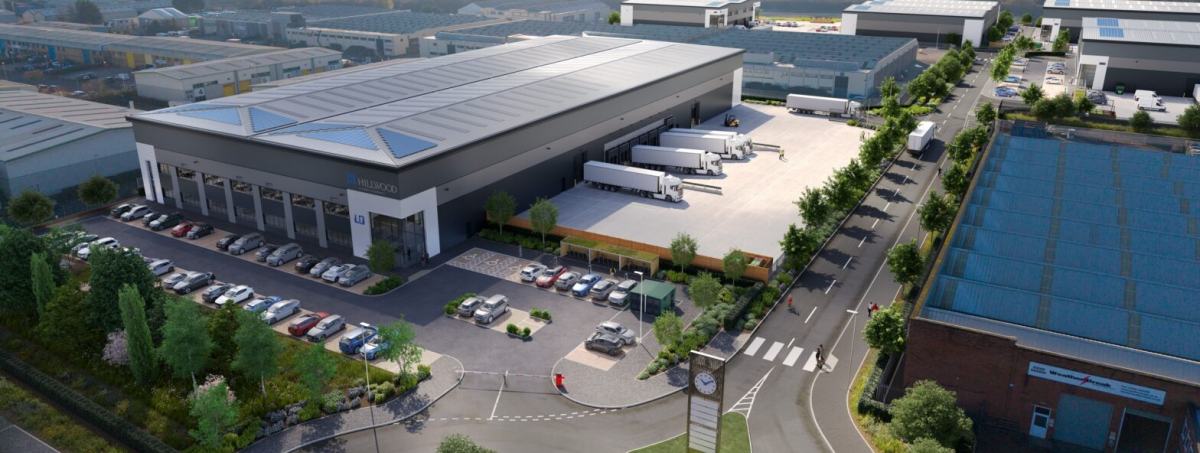
Hillwood Investment Properties has closed a £76.4 million development financing facility with Affinius Capital across two speculative ground-up logistics developments in Luton and Canning Town, East London, totalling approximately 329,659 sq ft; this is a real estate development financing, not an acquisition, and no equity consideration arises.
Hillwood Investment Properties is a Dallas-based global logistics real estate platform with a 30-year track record, having acquired and developed over 29 million sq m across six countries. In Europe, active since 2013, Hillwood has deployed more than €5.1 billion across the UK, Germany and Poland.
Affinius Capital is a San Antonio-based integrated institutional real estate investment manager founded in 1982 (formerly USAA Real Estate), with net AUM of approximately $31 billion as at March 2025 and a pan-European lending mandate providing whole loan and mezzanine capital. The two schemes are: an approximately 286,000 sq ft Grade A logistics development of eight units across five buildings at Luton along the M1 corridor; and a 43,659 sq ft last-mile urban warehouse in Canning Town (E16). Both are speculative developments targeting BREEAM Excellent certification. Advisors: none mentioned.
The structural driver is persistent supply shortage of Grade A UK logistics space. UK industrial vacancy stood at approximately 4.5% at mid-2026, with available Grade A standing stock in the M1 corridor and inner East London sub-markets running below 2% — a level at which speculative development at institutional specification is commercially rational.
The sub-facility structure across dedicated finance, carry cost and earnout tranches reflects the complexity of simultaneously funding a large-format multi-let distribution scheme and a single-unit urban last-mile asset under one facility.
The Luton M1 scheme addresses demand from national distribution operators requiring connectivity between Central London and the Midlands, a corridor where land constraints and local plan restrictions have suppressed speculative starts. The Canning Town last-mile unit targets urban logistics demand generated by London's e-commerce density, where freehold space in E16 commands premium rents in a market with no realistic land pipeline.
For Ireland, the transaction is a reference data point for Irish logistics developers considering speculative development at similar sub-5% vacancy rates in the Greater Dublin industrial market, where occupier demand from e-commerce and pharmaceutical distribution continues to outpace Grade A supply.
Source: hillwood.com / affiniuscapital.com / caplight.com / propertyweek.com








.png)