
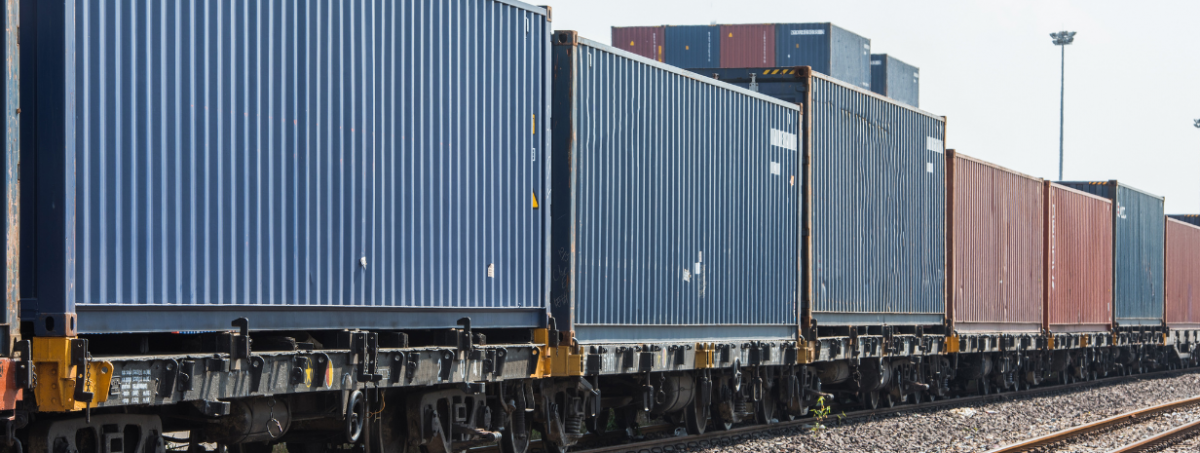
Ireland moves less than one per cent of its goods by rail, the lowest freight modal share in the EU, yet conditions for improving that figure are more favourable than at any point in a generation. The Rail Project Prioritisation Strategy 2025, published jointly in December 2025 by the Department of Transport and the Department for Infrastructure in Northern Ireland with European Investment Bank support, commits to a programme that will improve the infrastructure on which rail freight depends. It unlocks a cost-competitive, lower-emission freight channel open to first movers.
The strategy makes the commercial case for a reappraisal of rail freight compelling. Network capacity improvements including new passing loops, station platforms, and port connectivity upgrades will allow intermodal freight to operate more reliably. Three developments underpin the investment case: the maturation of the infrastructure pipeline, the global shift toward intermodal freight, and a tightening emissions environment raising the cost of road-only logistics.
The Early Interventions programme commits to new passing loops and platforms by 2030, with construction starting this year. These upgrades increase scheduling flexibility and reduce conflict on single-track sections. The strategy builds on Iarnród Éireann's Rail Freight Strategy 2040, targeting a rise in rail's freight modal share to five to ten per cent by 2040, with terminals at Athenry, Limerick Junction, and west of Dublin, and the Foynes line reconnection underway.
The global intermodal market confirms the direction of travel. The global rail logistics market was valued at $428.2 billion (€395.5 billion) in 2025 and is projected to reach $680.3 billion (€628.2 billion) by 2035 at 4.8 per cent CAGR according to Global Market Insights, with intermodal services the fastest-growing segment. Gardiner and Theobald confirm raising Ireland's rail freight modal share requires intermodal terminal investment and port connectivity upgrades, both embedded in the strategic framework. Operators who engage now will benefit as capacity comes online.
The emissions case reinforces the commercial logic. Road freight accounts for the dominant share of Ireland's transport emissions, and the regulatory environment is tightening through the Renewable Transport Fuel Obligation, rising carbon pricing, and EU fleet emissions standards. Rail produces lower carbon emissions per tonne-kilometre, and operators demonstrating intermodal capability will be better placed to meet sustainability requirements and access green procurement contracts.
Three actions merit prioritisation. Operators should engage with Iarnród Éireann's rail freight team to assess which flows are viable for intermodal transfer, starting with high-volume bulk and containerised corridors. Organisations should monitor the Early Interventions programme and terminal pipeline, positioning to participate in Athenry, Foynes, and Ballina infrastructure as it comes online. Boards should incorporate rail freight into multi-modal logistics and sustainability strategies.
Ireland's logistics sector has been limited by network constraints from accessing rail freight advantages continental peers take for granted. The Rail Project Prioritisation Strategy 2025 and Rail Freight Strategy 2040 represent the most credible framework for changing that. Globally, intermodal freight is growing, emissions requirements are tightening, and road costs are rising. Operators who develop rail freight capability now will lead the transition as infrastructure matures.
(The views expressed by the writer are his/her own and do not necessarily reflect the views or positions of BusinessRiver.)







.png)