

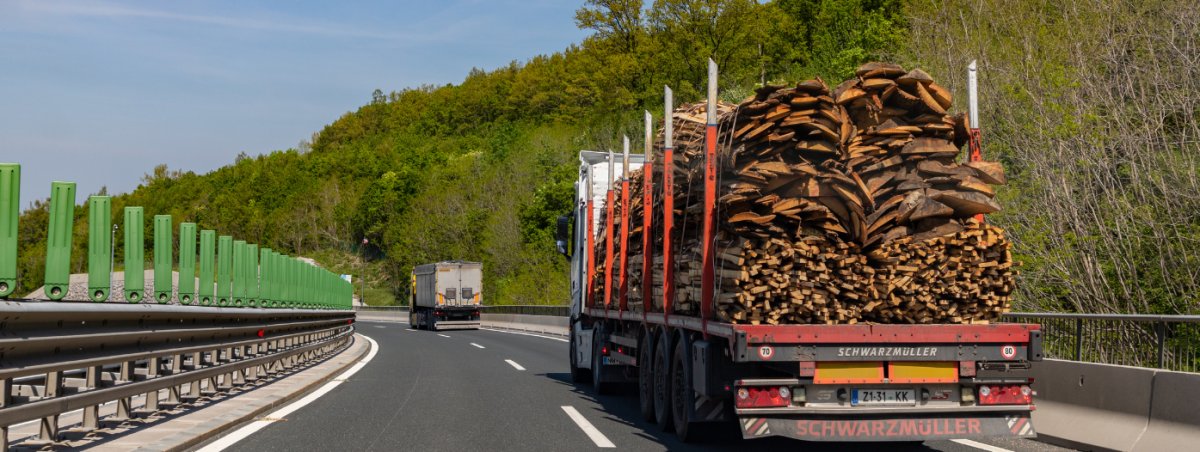
Heavy road freight is the hardest part of transportation to decarbonise, and Ireland’s forestry sector is tackling it collectively. Decarbonising Forestry: Log Haulage in Ireland 2026, published in September by FTA Ireland and Coillte, sets out a practical pathway built on shared data, real-route pilots and cost evidence. Its subject is demanding: 147 hauliers operating 483 vehicles at 46 tonnes on rural roads. It offers a template for every Irish operator running heavy fleets.
The report deserves attention beyond forestry because it treats decarbonisation as a supply chain management task rather than a burden for individual hauliers. Micro-fleets, which make up 82 per cent of log hauliers, progress fastest when mills, energy providers and manufacturers move with them. Three strengths stand out: a common data foundation, a cost case grounded in total cost of ownership, and immediate gains requiring no new vehicles.
Shared data is the first advantage. Coillte’s Haulage Logistics and Telematics platform is already standard across the log haulage fleet, giving one consistent record of routes, idling and fuel use. With TU Dublin, the industry plans a Forestry Logistics Heatmap showing energy providers where charging and refuelling demand will arise. ESB Networks and Gas Networks Ireland have endorsed the approach. For transport management teams elsewhere, it shows how pooled data lowers investment risk.
The cost case is the second. The report’s seven-year model places the total cost of ownership of an electric articulated truck at €454,400, against €566,540 for diesel. Higher purchase prices are offset by lower energy and maintenance costs over a working life. State supports now reach up to €500,000 annually for zero-emission heavy vehicles and €300,000 for charging infrastructure. Procurement decisions become clear commercial calculations.
Immediate gains form the third. Eco-driving delivers fuel savings of 5 to 15 per cent, and FTA Ireland is the first Department of Transport-approved provider of such training. Hydrotreated vegetable oil offers a drop-in transition fuel, informed by Department of Transport analysis of its availability for heavy goods freight. Abroad, Scotland’s Net Zero Timhaul trial saved around 80 tonnes of carbon dioxide in its first year. Operational efficiency can improve while longer-term technologies mature.
Three actions merit prioritisation. Operators should share standardised telematics data with customers and energy partners to plan delivery routes, reduce idling and cut the empty running that Eurostat tracks across road freight. Organisations should base vehicle procurement on total cost of ownership and secure grant support before specifying new fleet. Boards should embed approved eco-driving training and pursue pilots in partnership, following good practice from the Forest Industry Transport Group.
Ireland’s timber hauliers are small operators with a demanding task, yet they have produced one of the clearest decarbonisation roadmaps in Irish freight. Pooling data, testing on real routes and proving costs before scaling applies equally to distribution, construction and agri-food fleets. The forest estate recorded in Forest Statistics Ireland 2025 will keep timber moving for decades. Operators who adopt this collaborative model now will strengthen fleet management, lower costs and lead the transition with confidence.




.png)