

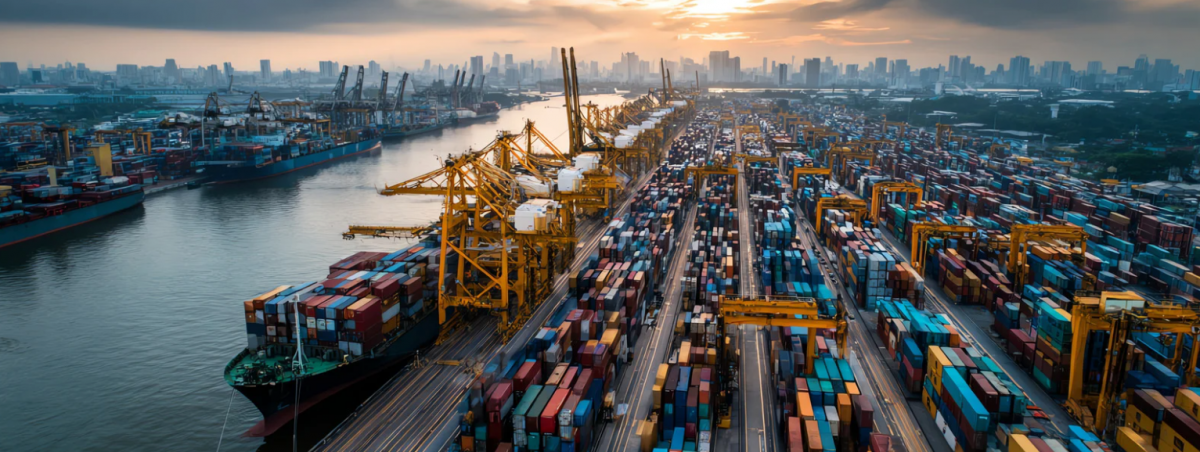
Ireland's manufacturing sector is expanding ahead of the broader European base, yet supply chains serving it are under pressure. The AIB Ireland Manufacturing PMI averaged 52.7 over twelve months to March 2026, with delivery times lengthening for eleven successive months. Input cost inflation is at its highest since December 2022 and shipping rerouting is adding ten to twenty days to schedules. For logistics and transport operators, demand and supply chain stress create a commercial opportunity.
The evidence for treating supply chain resilience as a revenue driver rather than a cost line is growing. Shippers pay premiums for logistics partners who demonstrate visibility, agility, and continuity under disruption. The OECD Supply Chain Resilience Review 2025 confirms import concentration is 50 per cent higher in the 2020s than the late 1990s. Three developments define the commercial opportunity: concentration risk reshaping procurement, nearshoring increasing demand for Irish logistics capacity, and digital visibility creating differentiation.
Concentration risk is driving shippers to rethink their logistics partner portfolios. The OECD confirms export restrictions on industrial raw materials have risen five-fold since 2009. In Ireland, firms have moved to forward ordering and dual sourcing to manage disruption risks. Logistics operators who support these adaptive strategies, offering network flexibility and re-routing capability, will be better positioned to retain contracts with manufacturers who need them.
Nearshoring is creating new demand for Irish logistics capacity. The Irish Times survey published in June 2025 confirmed Irish manufacturing sites are considered nearshored alternatives for critical raw materials, with Ireland's talent base, FDI infrastructure, and regulatory predictability as advantages. DHL's Trends in Logistics and Trade 2026, published in March 2026, confirms nearshoring and reshoring are long-term structural changes. As more production moves to or through Ireland, logistics operators providing reliable services will grow their freight bases.
Digital visibility is the enabling infrastructure for resilience-led logistics. Shippers managing disrupted supply chains increasingly specify real-time tracking, exception management, and predictive lead time data as contract requirements. The Nearshoring Loop study, published in Logistics journal in December 2025 and synthesising 107 academic studies, confirms supply chain resilience is the most cited benefit of nearshoring, with visibility and traceability cited as enablers. Logistics operators who build digital tracking infrastructure will win contracts generated by global supply chain restructuring.
Three actions merit prioritisation. Operators should invest in multi-route and multi-mode network capability, positioning as the logistics partner of choice for shippers managing disrupted routes. Organisations should develop supply chain resilience service offerings, articulating visibility, exception management, and continuity credentials in commercial propositions to manufacturing and export clients. Boards should assess nearshoring opportunities into and through Ireland, aligning depot network and capacity with sectors most actively restructuring supply chains.
Ireland's logistics sector is operating when conditions favouring resilience-capable operators have rarely been stronger. Manufacturing is growing, disruption is structural, and shippers are seeking partners who can provide reliability under pressure. The operators who treat supply chain resilience as an investment in commercial capability rather than a defensive response to risk will lead the sector through the next phase of restructuring.
(The views expressed by the writer are his/her own and do not necessarily reflect the views or positions of BusinessRiver.)








.png)